Showing posts with label writing. Show all posts

Monday, March 16, 2015

Author Visit Q&A

Last week I had an online school visit with a great group of students, but our time was cut short because of some
tech issues. Our test visit the day before was fine, but on the day of the actual visit, either I could hear them or they could hear me, but not at the same time. We finally gave up on trying to connect via webcam and they instead put me on speakerphone. It was already kind of a short visit, one of the 20-ish minute Q&A sessions that I offer to classes that have read Chained, so by the time we connected, there wasn't time to answer everyone's questions before the students had to leave for lunch.

I told them that if they'd email me the questions that were left I'd reply back, and I decided later that answering on a vlog would be more fun than an email reply; this offers more of a school visit-ish follow-up to the Q&A session that was cut short. Plus, other classes who've read the book can use the video also, and post questions to be answered in a later video. It's also on TeacherTube, for those of you who can't access YouTube at school.

So, if you like the vlog, the tech problems will have turned out to be a good thing!


Monday, April 7, 2014

The Writing Process Blog Tour


Thanks to my Class of 2k12 sister Gina Rosati for inviting me to be part of the Writing Process Blog Tour.  Gina is a library volunteer and author of AURACLE, an awesome YA paranormal romance from Roaring Brook Press/Macmillan. Visit Gina's website, follow her on Twitter, and read about her writing process here.

As part of the blog tour, I've been asked to answer these four questions about my writing process:

What am I working on?
Something totally different from anything I've written before--a young adult novel called Crashing Woodstock, about a modern-day high school senior who time travels to the Woodstock festival and faces horrors such as naked hippies, paper maps, and no cell phone service.

How does my work differ from others of its genre?
Hmmm. Well, I don't know of any Woodstock time travel books, so there's that. It will start and end as a work of contemporary fiction, but the bulk of the novel will read like historical fiction. Also I think in most time travel books, the character travels back in time on purpose, and this will be accidental.

Why do I write what I do?
In everything I write, there are characters I want to follow so I can find out what happens to them. I write for children and young adults because I love those ages of discovery, when we're still figuring out who we are, who we want to be, and who we don't want to be. We can really connect to characters who are going through the same things. Plus, I love middle grade and young adult novels myself--the stories have to be compelling from start to finish to keep choosy readers hooked.

How does your writing process work?
Well, this is somewhat messy. I'm not much of a plotter; I wrote CHAINED one chapter at a time, oftenThe Hero's Journey in mind along the way, though, so I'd refer to that when trying to coming up with what should happen to the characters. It worked out in the end, but I would've had a lot less revising to do if I'd done some planning. But I enjoy discovering the story as I go, so I don't think I'll ever be a heavy outliner. Now I do some rough plotting, with at least a few turning points that will come up throughout the story. I do my best drafting when I'm freewriting with a pen and paper, then I pull some of those ideas into a list of scenes for the chapter I'm working on. I talk more about organized brainstorming and plotting for non-plotters here, and how I've met the plotting/pantsing needs in Writing Lessons From Dogs.
having no idea what was going to happen from one chapter to the next. I was keeping
Also, I'm easily distracted, so I work best if I lock myself out of the Internet for an hour at a time. I use MacFreedom so I won't be tempted to check on all my friends who live in my computer.

Here's a little about the authors I've tagged for the blog tour. Look for their writing process posts next Monday, April 14th.

Gretchen McNeil's YA horror POSSESS, about a teen exorcist, debuted with Balzer + Bray/HarperCollins in 2011. Her follow up TEN was a 2013 YALSA Top Ten Quick Pick for Reluctant Young Adult Readers, a Romantic Times Top Pick, a Booklist Top Ten Horror Fiction for Youth, and was nominated for "Best Young Adult Contemporary Novel of 2012" by Romantic Times. Gretchen's 2013 release was 3:59, and this year, Gretchen debuts her first series, Don't Get Mad. Check out Gretchen's blog, Facebook page, or follow her on Twitter.

Anne Greenwood Brown is the author of the Lies Beneath trilogy - a series about love, forgiveness, and murderous mermaids on Lake Superior. She is terrified of high places, deep places, falling from high places into deep places, and fish of all kinds. But other than that, she's up for anything. Visit Anne on her blog, Facebook page, or on Twitter.

Leanna Renee Hieber is the award-winning, bestselling author of Gothic Victorian Fantasy novels for adults and teens. Her Strangely Beautiful saga, beginning with The Strangely Beautiful Tale of Miss Percy Parker, hit Barnes & Noble and Borders Bestseller lists and garnered numerous regional genre awards. Leanna's Magic Most Foul saga began with Darker Still, an American Bookseller's Association "Indie Next List" pick and a Scholastic Book Club "Highly Reccomended" title. Read more about Leanna on her blog, Facebook page, or on Twitter.

Thanks for stopping by!

Tuesday, February 25, 2014

6 Writing Lessons From Dogs

Comparing the dogs I've had reminds me of how different we writers are. Our goal is the same—craft stories that readers love—but how we reach that goal varies wildly.

I think we all know how smart dogs are and what great examples they offer about how to live. So let's look at a few lessons we can learn from them about how to be better writers:

1. Get out and play, but don't get lost
I will not leave your sight, human.
Some writers are like my last dog, Lacey. I could walk her without a leash, because she was never going to stray from the path. (She'd been a street dog, so maybe she was over the need to wander). But, she didn't know how to play. I tried introducing her to different toys, only to be met with blank stares. If Lacey were a writer, she'd outline every detail of a novel before starting the draft, and she'd stick to that outline until “The End.” She'd also miss out on some fun discoveries she might have come across if she allowed herself to explore new paths.

I'm a writer more like my current dog, Holly. She's the same breed as Lacey, but they couldn't be more different. Holly's an escape artist, always looking for a chance to take off and run free. If I let her off the leash, I have no idea where she'd end up, and neither does she. And she sure can play.
Squirrel!
Yes, I do need all the toys out at once


When I first took her to a dog park, I thought she'd take off like a greyhound as soon as she was off the leash. To my surprise, she wandered around the park, played in a mud puddle, then came back and sat next to me when she was ready to go. The fence provided just enough of a boundary that allowed her to explore and have fun without getting lost.
Wait, I see a puddle I missed


I also enjoy long walks
on the beach, as long as
I can see my people
Spike, the bulldog I grew up with, struck the right balance. He'd play soccer with us in the front yard, but he wasn't going to stray from home.

I'm not at all an outliner; I love seeing the story unfold as I write it. When writing CHAINED, I stumbled across some of my favorite plot points while researching or brainstorming new scenes. But, I can get lost if I have no structure. One reason the book took me so long to write is that I had no idea what was going to happen from one chapter to the next (and I'm easily distracted). Now when I write, I plan a few turning points. I still have the freedom to explore and discover the story as I go, but the stepping stones keep me from ending up lost in the wilderness.

2. Treat yourself
Find your own bacon bone
This is pretty self-explanatory, right? Anyone with a dog knows how much they enjoy their treats. It's a lot of work to get a book written, and finding ways to celebrate the small successes along the way can help us stay motivated. When you finish an especially difficult chapter, knock out a first draft, or finally hit "send" on a manuscript, treat yourself to a cupcake, a movie, or even a bone made of bacon if that's what you're into.


3. Form a pack
Dogs know the importance of traveling in packs. The wisest thing I did as a new writer was acknowledge that I couldn't succeed alone. My extended group of writer friends celebrates the successes of each member and offers support through the tough times.
As authors, we have the unique opportunity to let our readers know that they, too, are not alone. Reading is a solitary activity, yet stories make us feel less isolated. In the right story, we find our pack.


4. Do a little dance when your family comes home
Okay, maybe you don't have to dance, but at least look up from your work and say hi. I don't know what dogs are doing while we're out. For some reason Holly likes to Houdini her way into the garage as soon as I step out. For all I know she's building a flying car out there, but whether I've been at work all day or I've just stepped out to check the mail, she runs to the door to greet me and then does a few victory laps around the house when I get back. We won't be around forever, so it's nice to let our people know we're happy we're together for now.

5. Enjoy the moment
There's a lot about writing and publishing that we can't control. The story we're working on might not sell, and even if it does, some people won't like it. The only thing we can do is write the best book possible. And let's remember to enjoy the process along the way. There's a reason you started writing. Even though we have our struggles, we get some joy out of it too.
Dogs are great at living in the moment. Throw them a stick and they're not worried about what happened yesterday or what they're going to do tomorrow. They're just going to chase the stick for now. Holly had been neglected and was in pretty bad shape when she was turned in to a shelter last year, but as far as I can tell she's put that all behind her and seizes every opportunity to run around with a squeaky football.

6. After your hard work, get some rest
I know, you have more words to write today, but remember to take care of yourself. Your brain won't work as well if you're exhausted.
Stop and take breaks, and get plenty of sleep. Those squirrels aren't going to chase themselves, and you'll need your energy.

Yes, this is an acceptable mentor


Any other ideas, dog people? What else can writers learn from dogs?

Monday, September 30, 2013

Writing Lessons from Breaking Bad


Sigh. It's over. I'm sad to see Breaking Bad go, but I couldn't be happier with the ending. As always, everything makes perfect sense, although I didn't see any of it coming. Just one of the accomplishments of the show's writers: we know the characters so well, but the story surprises us at every turn, without getting ridiculous or forcing anyone do to something out of character.

A couple weeks ago I put out a call to Breaking Bad fans to share their favorite writing lessons from the show. Doing the post on my own was overwhelming since the list could go on and on, but a compilation of highlights from writers and other book people was far more feasible and fun.

So, on with the list. (Most of this is spoiler-free, but I'll let you know where to stop reading if you haven't watched the series).

From Diane Holmes: Here are some things I think Breaking Bad did very well: have your characters absolutely commit to their goals; make the next line of dialogue, the next action totally unexpected and within character; every win comes with an enormous downside; allow your characters to have huge memories about their own pasts that inform every moment of now; allow your characters to fail; and on and on!
---
Beth Fehlbaum: The characters use silence as an effective statement.
---
Helen Jameson: Breaking Bad is one of the best written TV shows. I have a few meth addicts in my family and was hesitant to watch anything that glorifies the life, but Breaking Bad does not do that. It's the gritty, bloody, sad, and addicted truth.
---
Jean Giardina:
- It's interesting when one character lies to another. But it's more interesting when a character lies to themselves.
- Terrible decisions make great story.
- A well-told truth can be as effective as a lie.
- Gus on Motivation: "I don't believe fear to be an effective motivator. I want investment."
- A character's greatest fear is often not death. Living is harder than dying.
- Sometimes, the worst thing you can do to your character is give them exactly what they want.
- The solution to today's problem becomes tomorrow's problem.
- Make it worse than your reader expects.
---
Lenore Appelhans: Watching Breaking Bad is a master class in subtext. You can see excellent examples of it in almost every conversation between Walt and Hank.
---
Author Gina Rosati hasn't watched the show (And why not? Get on that, Gina!), but asked her son what made it so compelling. He articulated how the writers cause our inner conflict about who to cheer for: "Walt is pretty much an anti-hero because he spends a lot of the show trying to build up a meth empire, and actually ruins other peoples' lives. Jesse is more the protagonist, even though it doesn't seem like he is. Even though he's a drug addict, he has a crap ton of morals and doesn't agree with what Walt is doing."
---
Claire Legrand admires the efficiency of the writing: No storyline, character, or set design element is wasted. Everything you see on the screen has a purpose, even if you don't understand what that purpose is at first. No time is spent exploring unnecessary side characters, plot threads, or details that exist "just because." Fantastic storytelling economy.
---
Nancy Paulsen mentioned the tight storytelling too: Everything on screen's got a purpose.
---
Tracy Abell: I watched the pilot episode before the finale and was (again) struck by how Walter White was set up as a sympathetic character. When that asshat kid in the chem class drags his chair across the floor, disrupting Walt's lesson, I'm 100% in Walt's corner. And that 100% backing of Walt continued for a while (even to the point of my cheering on meth sales! I mean, REALLY?!) I've never "supported" a character who did so much bad, for so long. That's a testament to creating sympathy. A powerful lesson for a writer. As for the female characters, I'm not so sure they were so fully drawn...
---
SPOILERS AHEAD, so come back to this part later if you haven't seen all the episodes!

Jessica Capelle:
- You can still have a satisfying ending even if it's not "happy" as long as you wrap up the loose ends and keep it true to the characters and the storyline.
- When a character is wronged, it's extremely satisfying to see him/her given the opportunity to choose whether to right the wrong or not, i.e. Jesse getting to go after Todd and having the option to take out Walt.
- A central image or motif can really connect aspects of a story, especially if you're writing a series. The recurring connection to chemistry with references to elements of it ran through the story and reminded us that elements are volatile when combined incorrectly and put under pressure. The recurring theme of surveillance and being watched added to the tension and excitement, and its role became more and more sinister as the story went on.
- Ask yourself "what if" but take it to the next level. BB constantly took things to places we didn't expect because the writers would continue to ask "what if" and pick something that still made sense in the story but was surprising to us.
There's more on Jessica's own post, so be sure to check that out too.
---
Jeff Coursey summed up the brilliance of the writing: One of my favorite things about the show is the way in which the characters are fused to the spine of the plot. Nearly every twist and turn comes from character choices. TOUGH character choices.

The writers are never afraid to put their characters into insanely difficult situations and then let them find their way out. Even the subtler moments have huge implications for the story.

I keep thinking of a scene in season four, when the Whites are at Hank and Marie's for dinner, and Walt has a little too much to drink. The camera zooms in slowly, focused on Walt's reaction, as Hank describes Gale as the supposed mastermind behind the blue meth. A genius, says Hank, not a meth cook. Gale was a five-star chef.

As we see, this is too much for Walt to take. Deep down, he wants recognition even more than he wants his freedom. In his stupor, he tells Hank that this was no genius, that from what he read in the lab notes, Gale's work amounted to no more than rote copying by a student. Maybe, Walt says, your Heisenberg is still out there.

As a result, Hank's interest in the case is revitalized. The trail leads him to Los Pollos Hermanos and Gus, putting Hank closer than he's ever been to exposing Walt as Heisenberg, and threatening Walt's family, the very thing Walt claims is his number one priority.

Walt's pride and need for recognition (his deeper desire) win out in the battle to provide for his family (his surface level desire). Throughout the show, his choices arc back and forth between the two motivations, creating rich storylines that are totally unexpected, but still totally satisfying.

At its core, this is what really drives the entire plot. A subtle conversation at dinner is enough to change the trajectory of the season, and along the way, the entire show.

I could go on and on about the intersection of character and plot, but I have to give a shout out to the props:
The GPS tracking device, the hat, the windshield with the blue tape (again and again), the eyeball from the burnt doll, the ricin, Walt's watch, even Jesse's wooden box in the final episode. The writers collapse storylines and infuse them into these objects as an ongoing image system. When they appear, we know where they came from and what they mean, both literally and figuratively. It's a simple and economical way to bring more emotion to the scene and more life to the characters.
---
Yes to everything. One thing I noticed from the start was the complexity of the characters. Like with my favorite character, Hank--at first he just seemed like an obnoxious jerk of a brother-in-law, but he was so much more than that. When he was alone, we saw that he was nervous and scared and trying hard to save face and act tough in front of everyone. For all the characters, there were times I loved them and times I hated them (or probably more accurately, loved them but hated what they were doing). Some stories are character-driven, others are plot-driven, and I think Breaking Bad is both. The characters' goals and faults drove their actions, which determined every twist and turn of the plot. I'd love to be able to write in a way that would put readers through such an emotional wringer as the Breaking Bad writers did to us.

If you'd like to read more about the show's writing, here are a couple of other articles I came across: one about why Breaking Bad is the new novel, and this Reddit post that Dotti Enderle pointed out to me.

Thanks so much to everyone who contributed. If you have more tips we didn't mention here, please share them in the comments! Also let us know how you're coping with the loss and what you'll be watching next. (Dexter for me, and I also have to catch up on Scandal).

Monday, September 16, 2013

Calling All Breaking Bad Fans!

If you're a writer and you watch Breaking Bad, you've certainly noticed that every episode, and the whole series itself, is a study in great writing. (And if you haven't been watching, get on it, people! You'll want to start with Season 1, Episode 1 and binge-watch the entire five seasons from there. Go ahead, I'll wait).

I've been wanting do a post on "Writing Lessons from Breaking Bad," but the task seemed daunting. Where to start? And where to end? The list could go on for days. There's no other show that's made me literally jump up and yell at the TV, then flop onto the couch in despair (usually right after they've made me think everything's going to be okay).

Then I thought about how many writers and other book people I know who are fans of the show, and every week we're talking about how amazing the writing is. So how about we compile a list of our favorites?

If you're a writer, author, or other book person, share with me a writing lesson from Breaking Bad, either here in the comments or by emailing me at lynne01[at]gmail[dot]com. Be as brief or as lengthy as you want. Throw in an example from a favorite scene, if you'd like. Include your website or blog address and I'll link to it in the final post.

The Monday after the last episode, I'll post the full list. And we shall support each other through the withdrawals.


Tuesday, July 30, 2013

Writing at The Lodge O' Death

Last month I attended a fabulous writing retreat in La Grange, Texas, with a group of Austin friends. Lots of fun yet productive, in a beautiful setting. The cabin, though, is affectionately known as "The Lodge of Death." P.J. Hoover had been before and has posted some great write-ups of the retreat.

Allow me to share some samples of the decor that give the cabin its nickname:

Yes, it's a fawn in it's natural habitat, a flower-filled rowboat.

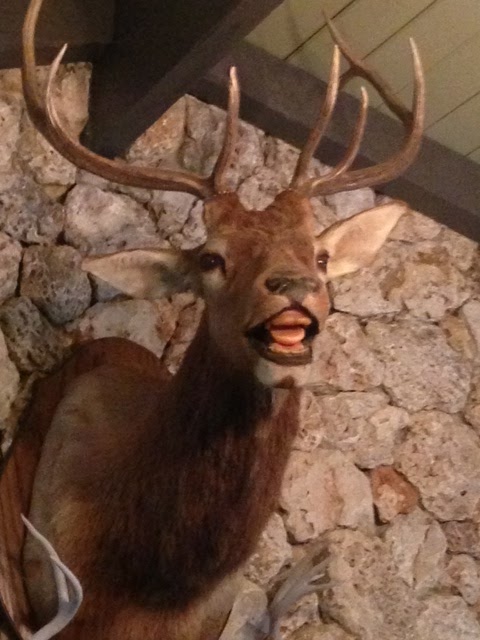
...it's even better close up. Pretty sure it's smiling.

Every bathroom should have a baby doll in a teepee

...unless it's a bathroom decorated with camouflage paint and antlers.

We even had fancy robes.

Light fixture too plain? Add more antlers.

And that's what's been missing from my flower arrangements too.
Antlers.

I know that expression doesn't look natural, but this is how they look when they're giving a bleat-out to the ladies.

Kind of wanted to pull the glue off the raccoon's leg, but also kind of worried that was the only thing holding him together.

This makes the bedroom more cozy.
Who wouldn't want this staring at you while you try to sleep?

Oh I see, it's a book rack. A really inefficient book rack.

Wait, that's better.

This guy has not seen the inside of the cabin.

And yes, there was even a framed print of a dog smoking a pipe.
But this was my view where I wrote from the screened-in porch.
My own contribution, the taxidermied wasp.
Okay, it's dead wasp on an index card, but I'm pretty proud.

As you see, lots of character in the place. Sure, most of the characters were stuffed and mounted, but I can't wait to go back!

Friday, May 24, 2013

Real-Life Writing Prompt: Carpool to Roswell

I mentioned in my last two posts that I attended the Kindling Words West retreat in Taos, New Mexico last week. I flew into Albuquerque with my buddy Crystal Allen, and we carpooled from there with Pam Bachorz since that would be more fun than the shuttle and it would allow us to stop at Trader Joe's for chocolate almonds and beverages.

While Crystal and I were waiting for Pam in the lobby of the car rental place, a woman approached us and asked if we were on our way to Roswell. If we were, she'd pay for half the car rental fee in exchange for a ride. She was visibly upset, like a chest-clutching, fighting back tears upset. Although that isn't where we were headed, of course we were intrigued. How does one just show up at a car rental lobby, suitcase in hand, looking to hitch a ride to Roswell? Apparently there's some giant new car rental tax the woman didn't know about, and her car for the week would cost more than her plane ticket had, and she was on her way to visit her mom. (No one else was flipping out about this tax, and ours wasn't that bad, so maybe it's something assessed if you don't reserve the car ahead of time. I'm not sure what the deal was with that).

Anyway, we started thinking about how this could be a fun story beginning. I know if we told thirty writers, "Strangers meet at a car rental desk and carpool to Roswell--go!" we'd get thirty completely different novels. Mine would a contemporary young adult novel with five different characters, each with a different reason they just had to get to Roswell, and their subplots would all become entwined somehow. Crystal was thinking of something more paranormal, in which the nice elderly couple offering a teenager a ride actually turns out to be aliens going to a reunion.

So, who would be in your carpool to Roswell, and why are they all going there? Why'd they show up at the same place without much of a plan?

Who knows, we might start a trend here. And in a few years we'll hear editors saying, "The market is saturated with novels in the Roswell sub-genre...".

Wednesday, May 22, 2013

Found Poems

I mentioned in yesterday's Catching Up post that I'd write a little more about our poetry lessons from
Nikki Grimes at Kindling Words West, so here's some of what we learned in just one of our five workshops last week.

I had a hard time thinking poetically, so it's obviously something I need to work on more. "Found poems" were a little easier for me because I felt like I had something to work with--in the confines of an article instead of the whole English language.

To do a found poem, take an article, a book page, even a recipe or a product label, and select words and/or short phrases from it to make a poem. You won't add any other words, so all the words in your poem come from the original text. And use the words in the order they appear rather than going back and forth in an article.

Here's an example, to give you a better idea of what it looks like. The first text I worked with was an article about a girl who developed an app that prevents texting while driving, since she was worried about her own mom's habits. Doesn't sound very poetic, right?

First, some excerpts from the article, "Puppy Love:"

The way 11-year-old Victoria Walker describes how she worries about her mom, you'd think their roles were reversed. "She's really bad with texting and driving," Victoria says. "I tell her to stop when I'm with her...I just needed some peace of mind."
The sixth-grader...came up with an idea for an app that would literally hound distracted drivers to putting down their phones. ...
Victoria's app, called Rode Dog, basically allows friends and family to form a pack to protect one another. A GPS tracks pack members, alerting the group when one of them is using their phone while driving--and then unleashes a barrage of barks on the phone of the offending driver. Walker says she was inspired by her own dogs...that "bark their heads off whenever they sense danger."...

And here's my found poem, made from words in that article:

Worried reversed
Tell her to stop
Peace distracted
Putting down friends and family.
A pack,
Alerting the group,
Unleashes,
Inspired by danger.

Here's another article, one that many of the workshop participants used, and it was interesting to hear such variety in our poems when the words all came from the same source. This is from a January 22, 2012 New York Times article, "Ready For the Worst, New York Gets First Major Snowfall:"

A powdery section of snow slid across the mid-Atlantic region and out toward sea on Saturday, making the season's first significant storm a less ferocious affair...
Yet memories of the crippling snowstorm in New York a year ago--followed by a blistering round of blame and recrimination--were fresh in the psyche of...residents of the region who readied themselves for the worst of winter's wrath. ...
Some New Yorkers saw the snow as a blessing, saying it had brightened winter's otherwise dry landscape.
"Finally, we're feeling winter,"...

I think so many people selected this article because it was so rich with strong words to mine for a poem. Here's the poem I made from the article:

Snow slid
Out toward sea
A ferocious affair
Memories, crippling, blistering
Fresh winter's wrath.

Or, a blessing
Brightened winter's
Dry landscape,
Finally.

Some people call these "blackout poems," because one way to do these is to cross out most of the words of the original text with a black marker, leaving only the words that make up your poem.

I think it would be a fun activity for students to do, like with an article they've used for research or a photocopied page of a book they've been reading.

Or try found poems yourself if you've been wanting to write some poetry but have trouble getting started. Let me know how it works out for you!

Thursday, January 24, 2013

10 Ways The Taste Is Like the Publication World


This week I watched the new cooking competition show The Taste, which is a lot like The Voice, but with a bite of food instead of a song.

A quick description if you're not familiar with it: contestants, who are either professional chefs or really good home cooks, have one chance--literally one bite--to impress the panel of superstar food people. If one or more of the judges falls in love with that one bite, they'll offer the chef a spot on their team. (From there I guess they'll compete against one another and have elimination rounds until there's one chef left standing who'll be crowned The Bite or something like that).

On the surface it probably seems to have nothing to do with writing, but it so much of what was happening reminded me of the struggle to become a published author.

Here are some things I noticed, and a few quotes, that especially hit home: (no quotes from Ludo, since I can't understand the guy. Seriously, I'd be in trouble if I were on the show and ended up on his team).

- Almost everyone made seafood. I found this surprising, since seafood is easy to screw up. Maybe if you're a good cook it makes for an impressive dish. But if everyone's serving up seafood, yours had better really stand out if you want to get attention.
And if you're trying to get published, write that vampire novel if you must, but it has to be especially awesome and offer something your reader hasn't seen before in all the other vampire novels out there.
Only one contestant made a dessert--a home chef, and she did get selected. The panelists were impressed, and Nigella is confident that she has the talent to make all kinds of dishes, not just desserts. Part of what made her stand out might have been that she gave them something different.

- "I liked it, but it's not for me." If you've been submitting to editors or agents for any amount of time, you've likely heard something like this. And it's not a bad thing at all. It means you're a good writer, but your manuscript hasn't landed on the right desk yet. You're giving scallops to someone who doesn't care for scallops.
Several of the contestants impressed the judges with their cooking skills, but the dish just wasn't the kind of food they love, or maybe it was too fancy-chefy when they're more of a comfort food fan.

- On the other hand, "I hate butterscotch. I have no idea where you pulled these ingredients from, but it strangely worked for me." This was Anthony Bourdain's response to the Chilean sea bass with butterscotch and cilantro dressing. Not usually his thing, but it was so good he had to take it on.
This reminded me of agent Faye Bender taking on Kristen Cashore's Graceling, even though she doesn't usually represent fantasy. Or the "rules" like "No rhyming picture books." You still see rhyming picture books getting published, right? So publishers do accept them, but they have to be stellar. It's hard to do well and not many people have the talent to do it, but when it does come together, it's beautiful.
Of course, do your research and submit to agents who you think will like your work, but if your book is amazing, they'll want to see more, even if it's something they don't generally gravitate to.

- "Were you stoned at 3:00 in the morning when you did this?" Another Anthony quote, one you don't want to hear about yourself. Agents get a lot of crazypants submissions. Don't be one of those people.

- Feel the fear and do it anyway. The contestants stood in a kind of elevator-thing, where they could hear the panelists' comments about their dishes. Sometimes the comments were great, sometimes they were terrible. It's a necessary step in moving on, but I can't imagine how intimidating that must have been. At least when we writers get rejected it's not in front of a national audience.
It's scary to send your work out there, but you won't get anywhere if you don't.

- But don't quit your day job. A few of the people mentioned they'd quit their jobs in order to try out for the show. A risky move, but a necessary one if they wanted to seize this opportunity and didn't have bosses willing to hold their jobs for them. Hopefully the ones who didn't make it will find new jobs soon.
I'm thrilled for authors who earn enough from their books to become full-time writers. But they're the exceptions to the rule; most of us won't be able to live the pantless life of a stay-at-home writer. It takes years to get published, and even after you sell a book, it might be a few months before you see the money. And most of the time, the money is a nice supplement to your income, but you'll need to continue doing something that brings in a regular paycheck.

- "There's too much going on here." This was a sentiment expressed several times, in one way or another, like with "This was a mishmash of flavor" or "My taste buds are still trying to figure out what happened."
Yes, you want to be original, but in a good way. Does your novel really need vampires, unicorns, wizards, ninjas, zombies, and mermaids? That's the literary version of pineapple maitake ground turkey sun-dried tomato mac-and-cheese stir-fry. (I did not make that up).

- Your kids love your cooking, but maybe no one else will. Like I mentioned in this post about query letters, of course your children like it when you write a story and read it to them, but mentioning that isn't going to impress an editor or agent. Every contestant on the show has family members, friends, even restaurant patrons who love their food. But like editors and agents, the panel of food experts had to be super-picky. They had room on their teams not just the great chefs, but the exceptional ones.

- Don't be a jerk. A good rule for life, really, not just for writing. Some of the chefs who weren't selected made comments like, "The people I've seen make it through are hacks" and "Nigella picked a woman who made mashed potatoes. I think my dish was a bit more complex than that." Well, you know what? Everyone likes mashed potatoes. "Complex" doesn't automatically mean "fabulous."
And are we sorry these people didn't succeed? Maybe it's shallow, but no. We cheer for nice people. People have long memories, and the Internet is forever. If you enjoy insulting reviewers and putting down other writers, expect to travel the road to publication alone.

- Not everyone chosen was a pro. Many of the contestants who made it through weren't professional chefs; they're just people who love to cook, and if we have a passion for something, we often do it well.
If you're unpublished so far, don't make any apologies for it when you submit your manuscript. You're a writer, and debut novels get published every month. If you love the work, keep doing it till someone takes a bite.

And am I the only one who wants to see more of Jeanette Friedman? Somebody give this woman her own show!

Thursday, January 10, 2013

The Query Letter Post: Hints For Writing Them, and the One That Got Me Represented

This week at the Houston SCBWI
It feels exactly this awkward to ask.
But if they like it, they'll put a ring on it
meeting I did a brief presentation about writing query letters, and was asked afterward if I'd send my own query letter from CHAINED to the group's listserv so members could have it as an example.

It occurred to me on the way home that it'd be better to include it in a blog post so I could share it with whoever would like to see it, and SuperAgent Joanna kindly agreed to add her own comments about what she thought when she first read the letter!

First, a quick definition of a query letter and a few do's and don'ts of writing them:

A query letter is a one-page letter that a writer sends to an editor or agent, asking to submit a completed manuscript. The goal is to concisely describe the manuscript in a way that will entice them to request it.

What to include in your query:

- A hook: one-sentence tagline to spark the reader's interest
- Genre and age group of the book: middle-grade fantasy or young adult contemporary fiction, for example. (But don't say "fiction novel" or you will get a punch in the throat)
- A mini-synopsis: a paragraph or two about the book, including the main characters and their problem
- A little about yourself: This is hard to write if you're unpublished, but mention if your line of work somehow has to do with your subject matter, or with writing or literature in general. Or just let them know you're in a writers' organization like SCBWI, for example.

What not to do:

x Mass emails. Of course you should be querying more than one person at a time; agents and editors often take a long time to respond, and you're not expected to wait two months or more to for a response before you send your query to someone else. Just don't fill the "To:" field of your email with every agent you've ever heard of. Select a few appropriate agents for your work, and if they accept email submissions, send them one at a time, personalizing the email to avoid a generic "Dear Agent" letter. (And check before clicking "send" to make sure the name in the "To:" field matches the name in the greeting).
x Mention that your kids loved your story. Of course they did. They depend on you for food. Telling the editor or agent that your children, grandchildren, the neighborhood kids, or your horde of cats love your book will not impress anyone and will mark you as an amateur.
x Fancy fonts or paper. You're probably emailing your query, but if you're submitting to someone who accepts snail mail, use plain white paper that you have not sprayed with perfume. However you send your letter, use a readable font like Times New Roman. I know, your letter written in Curlz font on purple glitter paper is adorable, but there'll be plenty of time for annoying your agent once you're represented.
x Compare yourself to J.K. Rowling. Another thing that will scream "I have no idea what I'm doing and I've done zero research." Let your work stand on its own and let the agent/editor judge the writing. You're not J.K. Rowling or Stephenie Meyer; you're you. Also, don't insult other writers and everyone in the industry by trashing existing books.

I think I can sum up what you should do by saying "Do a little research and follow submission guidelines." Submit to editors and agents who are a good fit for the kind of work you're doing, and always check the agency's or publisher's websites to see if they're accepting submissions and how they want you to send your query. Most accept queries by email now, but some do not. Some want the query letter only, while others ask that you include some manuscript pages.

Here are a few resources to check out for more information, though a Google search for "query letters" will give you approximately a kajillion thousand eleventy-pants more results, so there's plenty of information out there:

- Agentquery.com
- Query Shark
- Querytracker
- Writer's Digest (examples of query letters with agent comments)
- Harold Underdown's The Purple Crayon
- The SCBWI

And now, the query letter for CHAINED! I sent this to about thirty agents in all, and had several requests and eventually two offers of representation. Agent Joanna Volpe's comments are in blue:

Dear Ms. Stampfel-Volpe,

I have written a mid-grade novel of about 50,000 words that I'd like to submit to you if it sounds like something you'd be interested in reading. CHAINED is the story of two captives-- one a boy, one an elephant.
[This line already had captured my attention. I've been a long time animal lover (I had a subscription to Ranger Rick's well into my teen years. Don't make fun!) I don't typically see stories starring elephants, and I really liked the title.]

To work off a family debt, 10-year-old Hastin leaves his desert home in Northern India [Something else that piqued my interest. India! A fascinating and different setting than I'm used to seeing. My heart also went out to this kid immediately at having to work off a family debt.] to work as an elephant keeper. His new boss, Timir, plans to revive his old circus, starting with the elephant act. Hastin's new workplace is as strange to him as the green and humidity of the nearby rain forest. Why was this circus, which used to be the best around, forced to close down years before, only to be abandoned until now? How does the cook know everything there is to know about elephants? How does a person free an elephant from a trap, and how in the name of Ganesh does he take care of her when he does?
[I don't typically love when questions are posed in queries. More often than not, it feels like a forced way to catch an agent's interest. But in this case, there was something so innocent and naïve about the way the questions were asked. I just had this quick thought of "Hello, Hastin." I knew it was him.]

Surviving failed escape attempts, stolen money, an elephant hook, heat stroke, and a shared stable, the friendship between Hastin and Nandita the elephant grows stronger with each passing year, until they discover that the bond that links them together is stronger than any shackle, lock, or chain.
[This whole paragraph is great because it gives me a taste of what's to come, but that final line…I think we've used that in one way or another straight through to publication. I know I added it to my pitch! It's SO good. This might be the line that really captured me 100% because it really cuts to the heart of what this story is about.]

Author Uma Krishnaswami critiqued the manuscript and has been kind enough to offer to answer more questions about Indian culture if needed, and to read the story again to vet it before publication.
[This was just the icing on the cake to show me that she did her research—it certainly would have been one of my first questions when we talked.]  

A few editors have requested the manuscript, and I have listed them here, along with where I met them. :

·  [Awesome Editor A]  - First pages workshop
·  [Fabulous Editor B] - Highlights conference at Chautauqua
·  [Rock Star Editor C] - Houston SCBWI conference
[Since I had no writing credits or anything, this was sort of my "bio" and a way to show that I was actively participating in SCBWI events, for example, and getting my writing critiqued by editors, and to let them know there was some interest in the manuscript. ~Lynne]

Thank you so much for your time.

Sincerely,

Lynne Kelly

Hope these tips and the example help those of you who are working on your queries. Have any other helpful hints? Please share in the comments. Thanks so much to Joanna for taking the time to look over the letter again and adding her feedback!

Monday, December 3, 2012

How to Annoy a Writer This Holiday Season

Hi everyone!

Here's a little video I made for the Class of 2k12 blog recently, so I'm reposting here for your amusement. It has just a few of the funny questions writers often get, plus a message about what we're thankful for.


Writers, what other questions do you dread answering? And aren't you done with that book yet?

Thursday, August 23, 2012

9 Writing Lessons From Jaws

I already miss Shark Week. Seven days of sharks just isn't enough. So, I re-watched Jaws recently, and found that besides the entertainment value, it offers some good tips for writers.

There's plenty of wisdom in the movie, but here are nine lessons I found that apply to the writing life:

1. You're gonna need a bigger boat.
Writing can be a lonely journey. We do work in isolation most of the time, but it's much easier and much more pleasant with a support system. Find a group of local writers and/or online groups to network with. It's no fun to celebrate your good news or weather a storm all alone in your little boat. Have a community of writers to help you along the voyage.

Shark hunter Quint insisted his small boat was just
fine, and even wanted to shun any help and go
completely alone. And how did that work out, Quint? Oh, right, you can't answer that. You know, since the shark wrecked your boat and ate you. And great idea, smashing the radio to isolate yourself even more when you needed help.

Remember too that being in a writers' community is a reciprocal relationship; help out your friends when they need you. Don’t lie there drunk on the beach when they're getting mauled by a shark, you big jerk.

2. Sometimes subtle is better.
This bit of wisdom could also be called "Sometimes mistakes work out for the best." During the making of the movie, Bruce the mechanical shark wasn't cooperating. Steven Spielberg decided to use the ominous music to indicate the shark was nearby. That anticipation, the knowing what was coming without seeing it, turned out to be much more compelling than showing the actual shark approaching and attacking. Weaving in some foreshadowing or a hint that something's wrong lets that sense of foreboding creep in, and gives your story more suspense. Much more so than punching the reader in the face with horror. Or biting them in the face, as the case may be.

3. Have a plan, even if it's a rough one.
If you're like me, you prefer to see your story's plot unfold as you write it, rather than plotting it all out first. But it helps to have some idea where it's going. You can think about a few turning points in your story and where your character will end up and how they'll change, yet still have the freedom to figure out the details as you write.

Remember the guys who tried to catch the shark by tossing a roast into the water and chaining it to the dock? The dock they were standing on? Having no plan at all and no structure to hold on to can lead to everything falling apart beneath you. Chief Brody's team didn't know exactly how they'd catch the shark, but they had a boat, some weapons, and piano wire fishing line.

4. Chum the waters.
It seems obvious, but tell a good story that grab the readers’s attention. When Quint told the guys about his war experience in the torpedoed submarine, they hardly blinked, they were so fascinated. The details and the way the narrative unfolded pulled the listeners in, gave them some good suspense while they waited for what would happen, and didn’t let go till the end. Keep your readers intrigued and wanting more, so they can't help but turn the page to find out what will happen next.

5. Don't bite off more than you can chew, or anything that will explode in your face.
Be careful about overcommitting yourself. To make writing a priority, other things might have to slide. Only you can figure out what to take on and what to turn down, but it'll be up to you to schedule your writing time, or it'll end up being last on your list after you take care of everything and everyone else. Some people are good at taking advantage of small chunks of time throughout the day, while others need a larger block of time all at once.

And a note about explodey things. We know the shark met its (un)timely death via pressurized SCUBA tank. As long as we have the Internet, there will be people who enjoy annoying people. And they'll try to reel you in. Maybe they hated your book so much they feel compelled to email you and tell you about it. Or send you tweets about it. Or maybe they just enjoy arguing with anyone who will listen. So don't. Don't take the bait, don't bite down on the pressurized tank. 'Cause that just gets messy. Save yourself. Swim away.

When things are especially bad, lay low and emerge when the biting's done

6. Know when to call Richard Dreyfuss.
Chief Brody started reading a lot about sharks after those first attacks on the beach, but he knew that wasn't enough. After doing his own research, he called in a shark expert.

I don't know how many books and online resources I read about India, elephants, and Burma while writing CHAINED, but the best research I did was talking to people who've lived in those countries and to elephant experts. I learned things from their personal experiences that I never would have picked up from books or a website. Learn all you can about whatever you need to know for your book, but contact experts when you need to know more, or to check your facts. Reading on your own will help you figure out what questions to ask, but you can learn more from people who’ve lived in the world you’re writing about than you will by only reading. People are generally more than happy to talk about their passions, and if someone's writing about them, they want it to be authentic.

7. You'll get there faster if you don't hurry.
Quint, who was stubborn enough to insist his boat was adequate for catching the shark, also ran the engine too hard when the other men were warning him to slow down. It wasn't enough just to ignore their advice; he ran the boat even faster, until it finally broke down. His obsession with achieving his goal made him blind to common sense and good advice.

Writing a good book takes time. Getting published takes more time. Rushing into the publishing world, sending a manuscript too early, querying agents as soon as your first draft is fresh off the printer, will just leave you in a cloud of black smoke, adrift in your broken-down little boat. Take the time you need to write the awesomest book you can, then have it critiqued by writers you trust to give you honest feedback. Then revise it, and revise it again. And again, until you're at the point where you can't think of anything else to do to make the story better. Before you send it out, do your research to find reputable agents or editors who are interested in acquiring the kind of book you've written.

8. Have something to cling to when your boat sinks.
Most authors don't rely only on writing as their only income. Don't quit your "day job" because you want to stay home and work on your novel. I mentioned that a great book takes time to write, and once that's finished, the query and manuscript submission process can take anywhere from a couple of months to forever-ish. Hopefully your book is fabulous and will sell to a publisher for a hefty advance, but even if that does happen, it'll be a while before you see any of the money. Some of your advance will come few months after the sale, more after your edits are done, and maybe the last of it when the book is released, generally 18 months to two years after the sale. Not many people can survive that long between paychecks. (My idea-to-publication journey took six years, and that's not at all unusual).

When the Orca was in tatters at the end of the movie, our heroes didn't drown. They each grabbed on to a yellow barrel and stayed afloat.


9. Celebrate with maniacal laughter after a success.
...Or whatever else you'd like to do to celebrate. Of course you'll celebrate the book deal, but remember the smaller steps along the way too. Finishing a new draft, getting a request from an agent, catching an editor's interest--all of that gets you closer to your blowing-up-the-shark moment. Enjoy a nice dinner out, take a break to read a book, or buy a little gift to reward yourself.

I'm sure there are more writing lessons and/or life lessons in the movie, so let me know what others you think of.

So this tides you over till the next Shark Week, right?

I know, nothing comes close to Shark Week. But you didn't do much writing that week, did you?

Saturday, September 3, 2011

That's What (S)he said: Weekly Round-Up

The other day I wrote about several recent and upcoming elephant books for kids. Thankfully, you can never have too many elephant books, and none of them look similar to my own book. But maybe you've had that problem--you had a great idea for a book, then discover that someone else (or a few someone elses) wrote a book a lot like it. Now what? See Jen Nadol's guest post on the Cynsations blog, "Oh No! Someone Used My Idea!"

A trending topic on Twitter that's funny for some reason we can't explain and might have stolen some of my productivity this week is #replacebooktitleswithbacon. Some favorites: Are You There, God? It's Me, Bacon, How Stella Got Her Bacon Back, and Something Bacon This Way Comes.

One thing that keeps me reading a book is wondering how in the world the character is going to make it through his predicament. Are the stakes high enough in your own book? Not until the reader can't see a way out. Kara Lennox has a great article, "Is Your Black Moment Enough?" on Anna DeStefano's blog.

If you're interested in author marketing, be sure to bookmark Kristen Lamb's blog. We authors are really good at networking with each other, but it's harder to reach out to our readers online. "The Secret to Selling Books Part I--Let's Get Sticky", shows how we can better connect with our audience.

Here's a video I just saw today, but I have a feeling it'll go viral. Perfectly captures the emotional stages a writer goes through when writing a novel. I especially love the editing stage:


What happens to an elephant who survives a land mine explosion? If she knows the right people, she gets a giant prosthetic leg! Edited to add: Just saw that there's a documentary being made about the hospital that cares for this elephant and others injured by land mines. Learn more and see the trailer on the Eyes of Thailand website.

In other animal news, how can you not love a girl who punches a bear in the face to save her dog?

Have a fun and safe holiday weekend! Watch out for bears. But if you do see one, you know what to do now.

Sunday, August 28, 2011

That's What (S)he said: Weekly Round-Up

Hi, people!

It's an exciting time around here lately, with moving the daughter in to her new place for her sophomore year of college, listening to colorful descriptions of what it's like to assemble Ikea furniture, and maybe seeing a sketch of the cover art for CHAINED. (Nothing to share yet, but if I did see such a sketch, it's really awesome.)

Meanwhile, here are last week's favorite things found on the Internet:

I hope everyone on the East Coast is staying safe from the hurricane. Those who still have electricity (or plenty of battery life) are staying updated and sharing storm humor via Twitter. Here are a few funny tweets about Hurricane Irene from The Huffington Post.

Do you keep meaning to connect with people online, but feel like you don't have the time? See "7 Tips For Finding Time For Social Media" from Inkling Media.

Getting an agent is a huge step toward getting published, but what happens if your book doesn't sell? Edan Lepucki has a great "Shutting the Drawer" post on The Millions blog about that heartbreaking problem.

Now, a couple of fun elephant videos. This is fascinating-- an elephant's problem-solving when the fruit on the tree is too high:


And I love Ricky Gervais' take on elephants who have been "caught swimming:"


Reminds me of the cat who was caught barking:


I feel like a big tease giving you book recommendations this week, because the books I've been reading won't be out till next year! A perk of being in the Apocalypsies is that I'll have a chance to read some of the books before they're released. But put THE MAPMAKER AND THE GHOST by Sarvenaz Tash on your list if you'd like a good midgrade adventure, and FRACTURE by Megan Miranda for a young adult paranormal thriller you won't be able to put down.

Speaking of awesome paranormal YA novels, Gretchen McNeil's POSSESS was just released, so pick up that one if you haven't yet! But you'll probably want to sleep with the lights on.

Have a great week!